#ThisIsAppalachia: American Chestnut
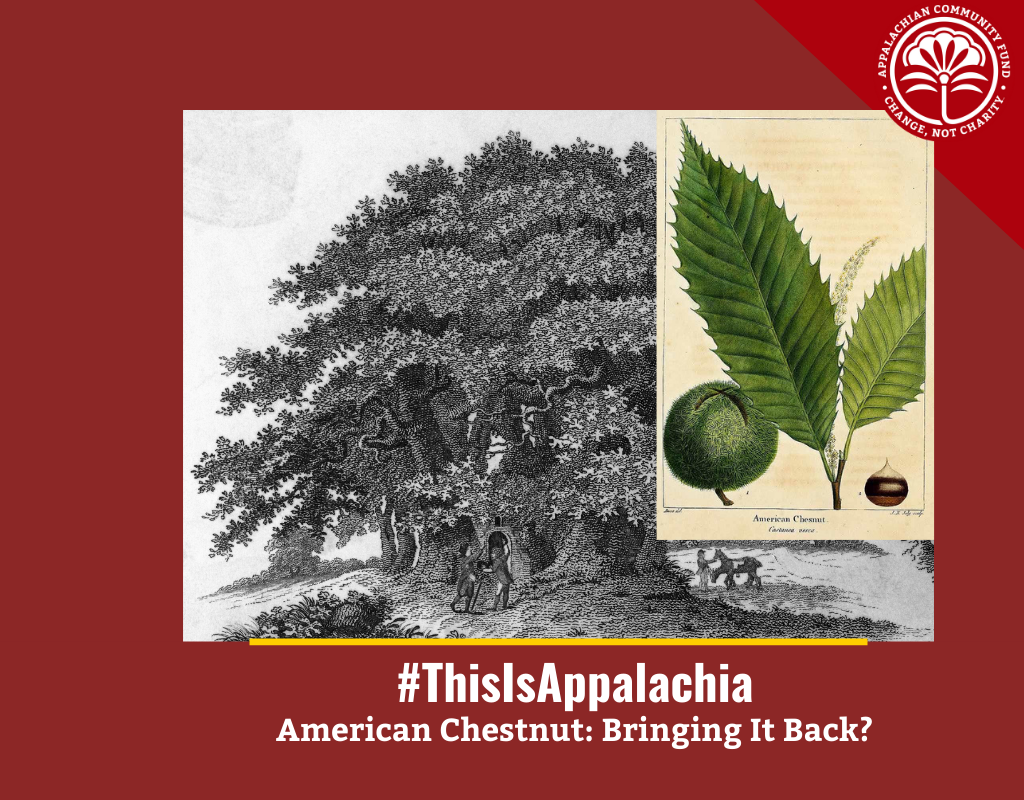
The American Chestnut
Bringing it Back?
By Don Davis
Sadly, the tree that most piqued the emotions of the 19th and 20th century American--the American chestnut--has virtually disappeared from the eastern United States. The species became functionally extinct during the early twentieth century, after an exotic fungus was introduced into the country on Japanese chestnut nursery stock. Before that time, the tree played an extremely important role in the ecology, economy, and material culture of the eastern United States. From Maine to Mississippi, the American chestnut was associated with street vendors, community gatherings, family picnics, holiday feasts, big-game hunting, fence building, logging, leather tanning, livestock husbandry, and even moonshining.For residents of Appalachia, where the trees defined the pre-World War II landscape, the loss of the American chestnut even served as a metaphor for the passing of a largely self-sufficient and forest dependent way of life. Although some Appalachian communities were home to only a single grove of trees, many areas possessed incredibly large stands of the American chestnut. George Ramseur, who lived in southeast Tennessee during the 1930s, recalled that chestnut trees atop the Cumberland Plateau were “as common as the moon rising and sun setting.” In the mountainous portions of Kentucky, West Virginia, Tennessee, and North Carolina, the trees comprised as much as thirty percent of the forest.I first wrote about chestnuts in my award-winning book Where There Are Mountains: An Environmental History of the Southern Appalachians, which was published in 2000. After learning how important the tree was to mountain residents, I later joined efforts to return the tree to the Appalachian forest and founded, in 2005, the Georgia Chapter of the American Chestnut Foundation (TACF). TACF has been using a “backcross” breeding method in its restoration efforts, which produces American/Chinese chestnut hybrids that closely resemble the native tree. To date, thousands of such trees have been planted in private orchards and on public lands, and many are demonstrating promising levels of vigor and blight-resistance.More recently, TACF has endorsed the development and planting of transgenic or genetically engineered (GE) chestnuts, which are being developed by William Powell of SUNY-ESF. The GE chestnuts possess a wheat gene that triggers the production of oxalate oxidase, which is harmful to the blight fungus. However, the trees will need government approval before they are released into the wild, which could happen as early as 2022. A third restoration effort involves locating surviving American chestnut trees that already appear to have some blight-resistance. Those trees are then bred with other such trees, producing offspring that often carry the blight-resistance trait. This approach is championed by the American Chestnut Cooperators’ Foundation, which has large orchards of trees in several states.Although I find none of the approaches very promising in the short-term, the latter one will no doubt best preserve the germplasm of the American chestnut. The backcross breeding method will likely get more chestnut trees in the forest more quickly, but it is yet to be determined how closely they will resemble the native tree. The GE chestnut might eventually prove effective against the blight fungus, but it is too early to tell what impact the trees will have on other organisms in the surrounding forest ecosystem. Because the story of the species is truly a cautionary tale, the public should be careful about fully endorsing the transgenic approach to American chestnut restoration.
 Author Don Davis appears in this photo taken by Marc Meyer, with perhaps the largest living American Chestnut tree on the planet. It's nearly four feet in diameter and more than 130 feet tall. It was planted from North Carolina stock around 1910 in Brussels, Belgium's Tervuren Arboretum.
- Donald Edward Davis' new book is The American Chestnut: An Environmental History (UGA Press, 2021). Since 2008, he has been involved in organizing the biennial Appalachian-Carpathian International Conference, an initiative that brings together community residents, activists, and scholars from two continents. Because of his efforts, numerous individuals from Appalachia have visited and conducted research in the Carpathian mountains of Ukraine and Romania. Dozens of individuals from the Carpathians have also visited or studied in Appalachia, as well as attending the annual Appalachian Studies Conference. These exchanges have helped participants learn more about our shared problems and concerns, including rural underdevelopment, environmental degradation, and post-coal initiatives.
Contact Walter Davis, walter@appalachiancommunityfund.org if you have a positive story about people, places, and things in Central Appalachia.