#ThisIsAppalachia: Resilience
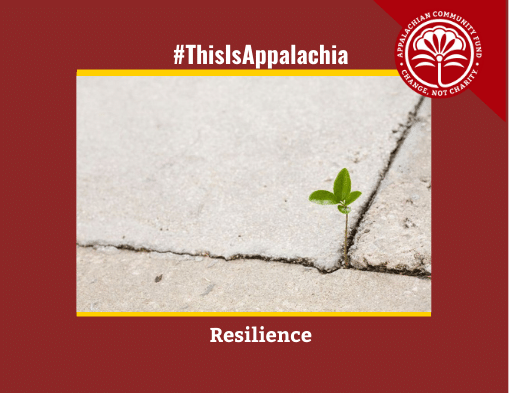
The Mayo Clinic says, “Resilience means being able to adapt to life’s misfortunes and setbacks.”The recent flooding in Eastern Kentucky and Southwest Virginia brought news cameras and reporters to the mountains to cover tragedy. All too soon, other tragedies like the polluted water system in Jackson, Mississippi, and the drought in the Southwest, drew the cameras to other emergencies. Meanwhile, many responded to the flooding crisis, none more than the people of Central Appalachia and people living elsewhere with roots here.As the reporters moved on, they commented that the people of Appalachia are resilient.Ali Stine wrote in No Elegies for Appalachia, “So many stories are told by strangers to Appalachia, reporters parachuting in and getting only brief, filtered glimpses of what day-to-day life is like in a city or town. But what about the people who live here and live daily with the consequences of policy at work in their own communities? Who are the people whose stories aren’t told?”We share here some examples of how resilience is shown in this moment but also year-after-year.(From Resilient, Rising Appalachia)*
… put us all together we make a mighty roar
I am resilient
I trust the movement
Gwen Johnson, Hemphill Community Center
Right now, sitting in an open shelter surrounded by boxes of detergent, rubber boots, canned beans, and shampoo, she clings to a well-known saying by Mother Teresa: “Not all of us can do great things. But we can do small things with great love.” Johnson, 64, excels at small things that add up to quite a lot. She chairs the board of the Hemphill Community Center, formerly its elementary school, and started the Black Sheep Brick Oven Bakery on the first floor as a way to make food locally and give employment to people in recovery…Johnson is the real deal, says Dee Davis, president of the Center for Rural Strategies. “She’s not like Pollyanna,” he said. “She’s been dealing with people who are fighting addiction, she’s created systems for people to get back in the workforce, she’s making a real difference. “Her story is what makes living here worth it,” he added. “It’s not because everything is good and we’re all happy, eating peaches and cream — it’s because living here is worth the fight and I think she’s worth the fight.”…Johnson will keep helping because that’s what she does. That’s what her mother, who died in February, did. But she can’t stop thinking about a boy with special needs and his grandma living under the carport and what else she can do for them. “What do you even do with all that?” she asked, her eyes welling with tears again. “It’s a lot. It’s just been a lot.”
Why major flooding won't drive eastern Kentucky families away
(excerpted from article, July 31, 2022 in the Christian Science Monitor)
Evelyn Smith lost her home and everything in it in the deadly floods that devastated eastern Kentucky, saving only her grandson's muddy tricycle. But she's not planning to leave the mountains that have been her home for 50 years.Among the stories of survival that continue to emerge, a 17-year-old girl whose home in Whitesburg was flooded Thursday, put her dog in a plastic container, and swam 70 yards to safety on a neighbor’s roof. Chloe Adams waited hours until daylight when a relative in a kayak arrived and moved them to safety, first taking her dog, Sandy, and then the teenager.“My daughter is safe and whole tonight,” her father, Terry Adams, said in a Facebook post. “We lost everything today … everything except what matters most.”Smith, the woman who salvaged her 2-year-old grandson’s trike, said fast-rising water forced her from her trailer around 1:30 a.m. Thursday.“Everything in it has got mud all over it,” she said. “There’s probably 6 to 8 inches of mud in the rooms. The walls are all water-logged all the way up.”Despite all that, she's not leaving Knott County. She doesn't think she ever could. “It’s the mountains," she said. “It’s the land, it’s the people that connect together to make it a home.”
Resilience for mountain farms means tradition and innovation
(May 29, 2017, Meadowcreek excerpts)
Mountain farms have a unique character. Often one family has made a living on the same piece of ground for generations. An example we can all learn from is a farm in Clay County, Kentucky, where the same family has been farming since the land was settled 140 years ago. Like most resilient Eastern Kentucky farms, it was established along a river and includes bottom land and gentle slopes moving to steep forested mountains. …Will Bowling’s people acquired the land when Squire Hensley bought a sizeable plot in 1870. Will’s parents moved to the farm when one of their cousins decided to move on. “He was getting out of farming right as my parents were getting in.”Another big help for farms and food systems in Eastern Kentucky has been the Community Farm Alliance. They have launched the Appal-TREE program, which is responsible for the Farmacy program, cooking programs, lunch programs for school children, as well as farm development assistance. …Eastern Kentucky has a culture that is very tied to family and place. Will’s family and farm is evidence of this, five generations later there are still family members on the old homeplace, working the land. Will recognizes that in most places in the rural South falls victim to “brain drain.” That is, many people who grow up in a rural setting end up moving off of the farm and towards city centers where they can get educations and jobs other than farming. Will went to college, but he knew that he would be coming back and a lot of that decided what he was going to major in. He wanted to get a job that would not only ensure that he was able to go back to Eastern Kentucky to work, but that he would be able to come back to the old home of his family and have a job. Wildlife conservation work was a suitable pick, and he feels very thankful that he was able to find employment.Will was also fortunate to have the family farm to come back to. Having a community and family to come back to is important to him. He contends that most people around Eastern Kentucky also feel a sense of kinship to the land. Being able to make a living off the land or at least to provide enough sustenance to feed one’s family is a cornerstone of Appalachian culture. He sees this as a very important cultural characteristic and one that he sees only growing stronger in the future.… Even people who have left feel deeply tied to the land. Will noticed that when he was in college, all of the Eastern Kentucky folks seemed to gravitate towards each other, so many of his friends shared his traditional values…
Resilience
by Ivy Brashear, originally published by YES! magazine
Granny Hazel taught me how to feed the chickens. Hold the ear of dried corn in both hands and twist to pry the kernels from the cob, then throw it out into the yard for the waiting chickens to eat. I loved watching them peck away at the ground, eating the corn our family had grown that summer. At 5 years old, I’m sure I thought the chickens were her pets. Maybe I thought she just fed them like that because she liked to watch them peck at the ground, too, softly clucking as they did so.It wasn’t until years later that I learned she killed those chickens by twisting their necks with her bare hands to feed her family. This gentle, kind woman did what she had to do, just like countless Appalachian women before, during, and after her time….
Resilience is Appalachia’s Future
Ali Stine in No Elegies for Appalachia encourages understanding the real story of the region’s people: “You should be fascinated by Appalachia’s diversity and resilience. More than 200,000 square miles and home to more 25 million Americans, it has such a venerable history of organizing, community action, and struggles for justice. With a long tradition of environmental stewardship, Appalachia is and has been on the front lines for environmental justice, a movement led by women, especially older women, and women of color. Appalachia is full of towns rising up against outsider interests, working together to build clinics, save lives, and improve their own communities…You should be fascinated by Appalachia, but not because it was forgotten. It has been working this whole time. There is no one story of Appalachia—and there is no single song, but many. And they’re not elegies. They’re marches.”*Resilient, Rising Appalachia—see lyrics of Resilient Appalachia online here.
Contact Walter Davis, walter@appalachiancommunityfund.org, if you have a positive story about people, places, and things in Central Appalachia.