#ThisIsAppalachia: Communities Building Digital Equity
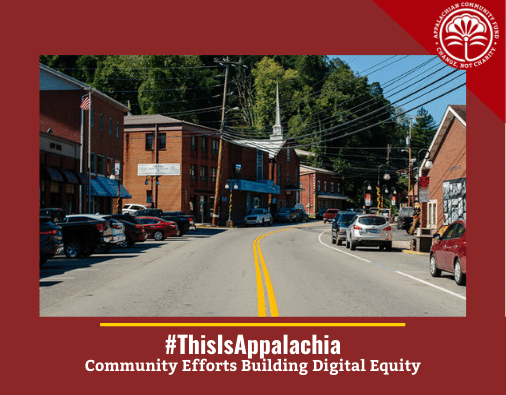
In a time when Zoom meetings, virtual workshops and working from home are common, rural Appalachia faces a growing disparity of access and opportunity. For students, it often presents frustrating and discouraging barriers to learning. Many communities are pushing against these limitations. Rural electrification and telephone services were previous struggles for equity. In this #ThisIsAppalachia, we have excerpted from a story of how Leslie County in Eastern Kentucky has faced the challenge. Thank you to Jessica Fregni of Teach for America, for permission to draw from the “This Community Set Out to Bridge the Digital Divide” from One Day, January 21, 2020 (see web address below).
This Community Set Out to Bridge the Digital Divide
May 10, 2021 , Jessica Fregni, Writer-Editor, One Day, Photo by Jacob Biba. Teach for America. Excerpted.
Slow internet was hindering students in one Eastern Kentucky county, so the community came together to do something about it.Inside the Leslie County Area Technology Center, a brick rotunda building located next to Leslie County High School in Appalachian Eastern Kentucky, Doug Napier’s information technology students toiled away on one of their most important projects yet.They were programming a fleet of miniature computers known as Raspberry Pis, each about the size of a deck of cards and housed inside old video game consoles. Their purpose? To get an accurate record of average internet speeds of Leslie County households over a 72-hour period.These speed test computers are still being used in an ongoing project led by Frank Baker, the information-technology (IT) coordinator at the local Hyden Citizens Bank and a lifelong resident of Leslie County. That’s because in Leslie County, a county of about 11,000 people nestled in the rugged mountains of Eastern Kentucky, the options for residents seeking reliable, high-speed internet are few and far between. For many families in Leslie County, their internet is too slow to reliably support video chatting, telecommuting, HD video streaming, and other online activities that most take for granted. …“The kids were telling their parents about it. They would get the devices and just pass them from owner to owner, house to house,” Frank says.This is just one example of the type of homegrown solutions that rural communities like Leslie County are developing in response to the digital divide that is hindering education and economic opportunities in the region. It’s a problem that seemingly the entire community is invested in fixing.“The community wants a change not only for themselves, but for future generations,” Frank says. “We need high-speed internet here to be able to keep people in the county and not moving out to find jobs and education elsewhere.”The Broadband Gap is an Equity IssueMost rural households are able to access the internet in some form—if not by cable, then by satellite, dial-up, or mobile. But that doesn’t mean their internet is fast enough to handle essential online activities for school or work. This is what’s known as a rural broadband gap or the homework gap. “Hereat the school specifically, we have what is considered high-speed internet... but it's what was considered high speed maybe eight or nine years ago,” [Teacher Lydia Weiso]… Leslie County High School is a 1:1 school, which means all students have Chromebooks they can use in class to learn. While the high school’s internet works well when a few students are on the network, it becomes strained by the demands of educational technology games like those on Google Classroom when all the students in a classroom are using their Chromebooks at once. It can become downright unstable during school-wide state testing, and during these high-stakes exams, the internet sometimes crashes.…The Psychological Impacts of the Digital Divide“You see students getting discouraged while they're testing,” Lydia says. “You see students getting discouraged when they're trying to complete a project and it takes them an extra long time.”For students, the rural broadband gap means so much more than the inconvenience of not being able to complete assignments at home. It harms their self-esteem and causes them to internalize harmful stereotypes about the region in which they live.What's Possible for Appalachia’s Schools When Internet Isn't an Issue.… “A lot of people think, ‘Get an education and leave, there's nothing here.’ We can't have that mentality,” says Robert Roark, the principal of Leslie County High School. “We need our own doctors, we need our own nurses, we need our own teachers, if we're going to improve our way of life here and the community.”To read more of this story and see how students, teachers, and town leaders are responding to the digital divide, go to https://www.teachforamerica.org/one-day/top-issues/this-community-set-out-to-bridge-the-digital-divide
Contact Walter Davis, walter@appalachiancommunityfund.org if you have a positive story about people, places, and things in Central Appalachia.